 UniqueizerPRO
Unique video hash for A/B tests
A file hash is a short fingerprint of the bytes. Change one pixel and it changes completely. That property is what makes it useful — and what makes "I renamed the file" useless.
A hash describes the content, not the name. Renaming, moving or re-uploading the same bytes leaves it identical. Re-encoding, cropping, colour and grain change it, because they change the pixels.
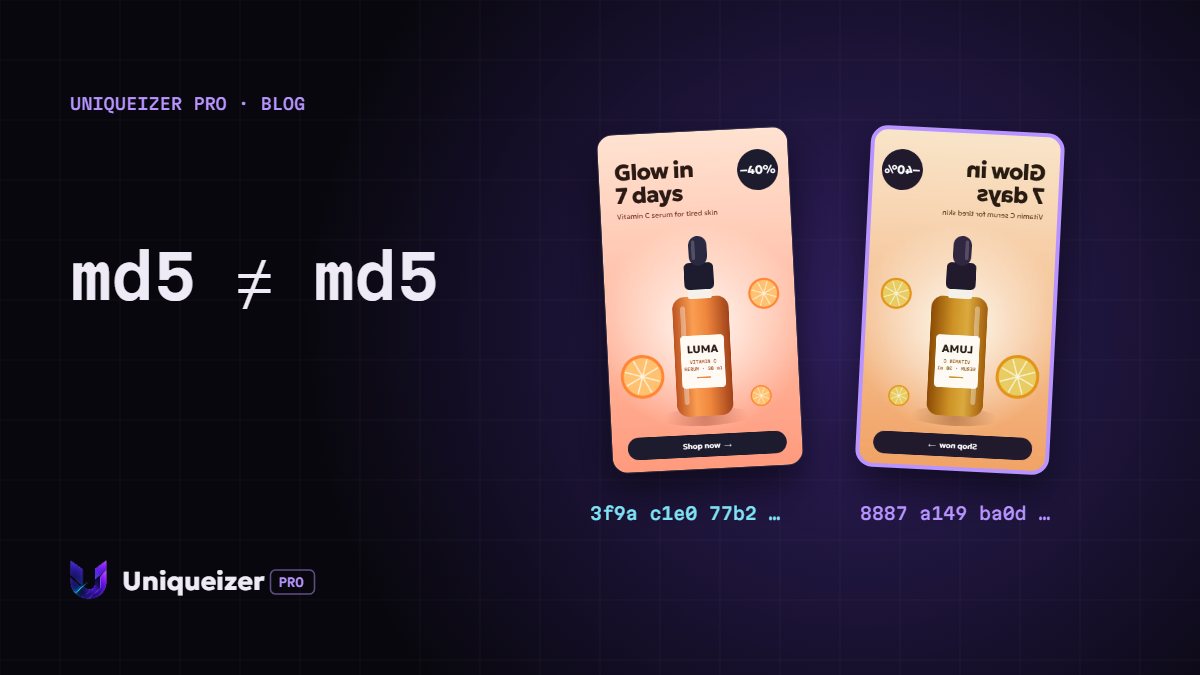
What a hash is
A hash function takes a file and returns a fixed-length string. Two identical files always give the same string; a single changed byte gives a completely different one. Ad platforms use fingerprints like this to recognise files they have seen before.
What does not change it
- renaming the file;
- moving it to another folder;
- uploading it from a different account;
- putting it in a different campaign.
All of these leave the bytes untouched, so the fingerprint is the same.
What does change it
| Change | Hash changes? | Visible? |
|---|---|---|
| Re-encoding with different settings | yes | barely |
| Micro-crop | yes | barely |
| Colour adjustment | yes | slightly |
| Added grain | yes | at low levels no |
| Speed change | yes | slightly |
| Metadata only | yes, but content identical | no |
Why it matters in a test
If three ad sets run what the platform considers one creative, you are not comparing three creatives. Delivery may be uneven and history may carry over, so the numbers describe audiences rather than angles. More on that in the article on identical files.
What to actually do
- Change the picture, not the wrapperCrop, colour and grain, not just metadata.
- Combine several parametersOne parameter alone leaves variants too close to each other.
- Check they differ from each otherNot only from the original.
Questions people ask
Does renaming a video change its hash?
No. The name is not part of the content, so the fingerprint stays identical.
Is changing metadata enough?
It changes the file but not the picture. It is the weakest possible difference and not worth relying on.
How much do I need to change for a different file?
Technically, one pixel. Practically, enough that variants differ from each other too — crop, colour, grain and, for video, speed.